Saturday, April 9, 2016

John Brown in Kansas


Before I start talking about John Brown – there is another place I visited that was related to the abolitionist movement and occurred before John Brown came to Kansas.  It was the initial trial regarding whether Dred Scott should be free.  Dred Scott was the slave of a surgeon – John Emerson – who worked for the Army.  During the time that he was a slave Emerson was located in Illinois and Minnesota – both free states.  In 1843 Emerson died – leaving Scott to his wife.  Dred Scott had saved money to purchase his own and his wife’s freedom – however Emerson’s widow refused to allow him to purchase his freedom.  So he sued.  He sued based on a Missouri law which stated that if a slave had been in a free state for a period of time then he was actually free.  The jury in St. Louis found in his favor in 1847.  The supreme court of Missouri however decided against him.  The statue below of Scott and his wife is at the old courthouse in St. Louis – just across from the arch.


He then filed a federal law suit.  The case made it to the Supreme Court.  The majority decided against Scott – stating that anyone with African ancestors, regardless of whether they were free or slave – were not actually citizens of the United States and therefore they did not have any rights under the constitution.  As chief justice Roger Taney would state – “blacks have no rights that the white man is bound to respect.”  Let that sink in for a bit.  The decision reversed the Missouri Compromise.  It basically put Blacks on the same level as any property.  Taney was from Maryland.  There is actually a monument of him about a block away from where we lived in Baltimore – in Washington Monument Square.  In 2008 I went there to celebrate Obama’s victory along with hundreds of others.  I thought how ironic it was that we were celebrating a biracial man’s victory beneath a statue of a man who denied the rights in America of all descendants of Africa.  

The very first place I visited on my sojourn south was Osawatomie, Kansas.  Don’t worry – I hadn’t heard of it either until I was researching where I should go for my trip.  In 1854 the Kansas-Nebraska act was passed.  It opened up the territories of Kansas and Nebraska to settlement.  As a compromise between North and South it was going to be up to the settlers to decide whether the new territories and soon to be states would be slave or free.  The unintended consequence was that radicals on both sides flooded Kansas.  Proslavery folks came from as far away as Georgia – although much of the violence was from Missourians who wanted their border state to be slave.  Many abolitionists from the Midwest and Northeast came to Kansas to attempt to make it free.  As a white person, I think it’s fair for me to say that us white people have done a lot of awful stuff in this country – but I’m pretty proud of that fact that white people actually uprooted themselves and moved close to 1,000 miles in some cases in the 1850’s to fight for the rights of Black people.

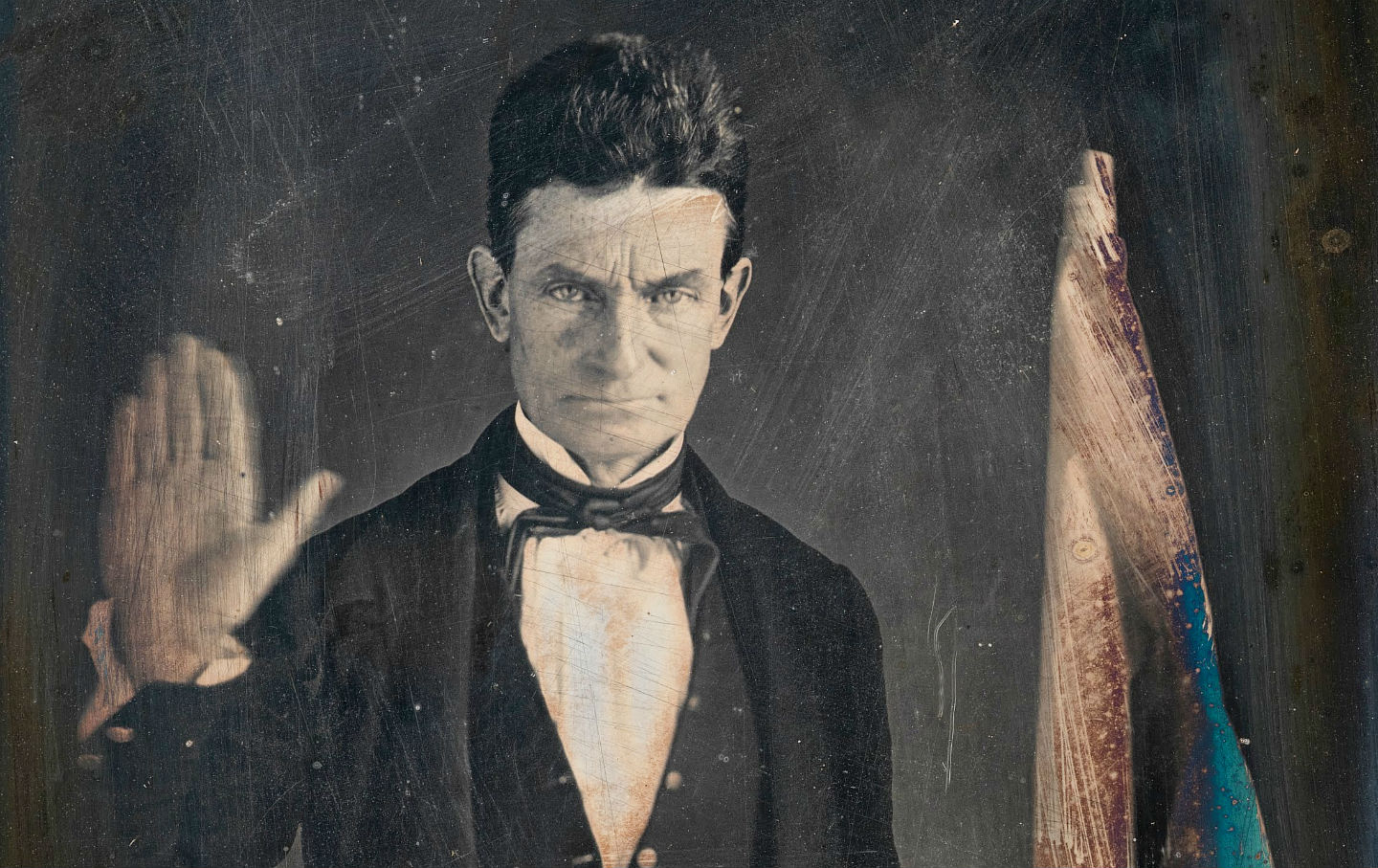
So now we get to John Brown.  The basic question is – was he crazy and just happened to be on the right side of history?  Or was he a great man – who is misunderstood?  I’ve done a lot of thinking on this.  He certainly had his heart in the right place.  He talked about his awakening of the evil of slavery as occurring when he was a young boy.  He was friends with a black boy – who was a slave.  He saw the owner of that boy beat him viciously for no real apparent reason. 

On the other side was the fact that he was a complete failure in life.  He never was able to be successful in business.  In 1843 four of his children died from dysentery.  The man has the feel of someone who was desperate to do something great because most of his life had been a failure.

In 1855 he moved to Kansas to help protect abolitionists – who he believed were not capable of protecting themselves.  The sacking of Lawrence appeared to support his beliefs.  Even more so was the beating of abolitionist Senator Charles Sumner by South Carolinian representative Preston Brooks.  He felt as though the abolitionists needed someone who was capable of violence against the pro-slavery supporters – and he was that man.

J.L. Magee’s political cartoon about the attack on Sumner.
John Brown and his men – who included many of his sons – did perpetrate some rather questionable acts.  The most questionable action was a nighttime attack against five pro-slavery men in Pottawattamie Creek – who were killed with broad swords.  This attack led to a greater organization of Missouri pro-slavery men who were bent on attacking abolitionist settlers in Kansas.  The focused their attacks on Brown.  They were determined to capture him.  On August 30, 1856 250 proslavery men from Missouri came to Osawatomie to hunt down Brown.  Brown only had 31 men to defend himself.  He used guerilla tactics to attempt to lure the proslavery men away from the town of Osawatomie. 


John Brown and his men took up such a favorable position, that the proslavery men did not attempt to go after them.  However, the proslavery men did come back and burn down the town of Osawatomie.  Soon after, John Brown went back east.  He was able to get funding from abolitionist for his idea of starting a slave insurrection. On October 17th, 1859 he and 18 men attempted to raid the armory of Harpers Ferry.  They were defeated by men led by Robert E. Lee – eventual General of the Confederate Army.  John Brown was put to death – but his insurrection terrified the South.  They saw it as proof that the North would not allow slavery to stand.  The election of Abraham Lincoln in 1860 only furthered their fear.  18 months after Harpers Ferry – the Civil War started – with the bombardment of Fort Sumter.  During the war the Union soldiers favorite song to sing on the march was “John Browns Body” – which was set to the same tune as the “Battle Hymn of the Republic.”

Tomorrow a few of the Civil War sites that I visited on my trip.

kdf

Thursday, April 7, 2016

Lovejoy


The above monument can be found in Alton, Illinois – a town on the Mississippi just up river from St. Louis.  It memorializes Elijah P. Lovejoy.  Lovejoy was born in Maine in 1802.  After college he traveled west and settled in St. Louis, where he worked for an anti-Jackson newspaper.  Eventually he went back east – studying at Princeton Theological Seminary – and became an ordained Presbyterian minister.  He came back west and started an abolitionist newspaper in St. Louis.  Missouri was a slave state and didn’t appreciate an abolitionist newspaper being printed in their state.  His press was destroyed three separate times – which eventually caused him to move across the river to Alton – in the free state of Illinois.  However, as we will see, the people of Missouri were out to fight against abolitionists regardless of whether they were in their state or in an adjoining state.  On November 7, 1837 a proslavery mob came to destroy his printing press in Alton.  Lovejoy, along with many of his supporters were armed and ready to defend his property.  The mob proved to be too much for them.  Lovejoy was killed one day short of his 35th birthday and his press was thrown in the Mississippi.
Like several other abolitionists who would be killed during this period, Lovejoy’s importance is not so much about what he did in life – but who and what he inspired in his death.  At the time there was a 28 year-old state representative in Illinois who took notice of what had happened to Lovejoy.  That representative wrote a speech, which the historical record first shows him giving to the Young Man’s Lyceum in Springfield, Illinois on January 27, 1838.  That 28 year-old was Abraham Lincoln.  Google it and read the whole thing – it is such an incredible speech – it carries an incredible moral power, but also an appeal to reason.
He starts out talking about how wonderful the country is that his generation had inherited from their forefathers – remember, the American Revolution had only happened 50 years prior.  More time has passed since World War II to our present, than had passed between 1776 and Lincoln’s speech. The topic he gives for the speech is the “perpetuation of our political institutions.”  Here are some of my favorite passages.  “It” – meaning how we will perpetuate our political institutions.
“How then shall we perform it?--At what point shall we expect the approach of danger? By what means shall we fortify against it?-- Shall we expect some transatlantic military giant, to step the Ocean, and crush us at a blow? Never!--All the armies of Europe, Asia and Africa combined, with all the treasure of the earth (our own excepted) in their military chest; with a Buonaparte for a commander, could not by force, take a drink from the Ohio, or make a track on the Blue Ridge, in a trial of a thousand years.
At what point then is the approach of danger to be expected? I answer, if it ever reach us, it must spring up amongst us. It cannot come from abroad. If destruction be our lot, we must ourselves be its author and finisher. As a nation of freemen, we must live through all time, or die by suicide.

I hope I am over wary; but if I am not, there is, even now, something of ill-omen, amongst us. I mean the increasing disregard for law which pervades the country; the growing disposition to substitute the wild and furious passions, in lieu of the sober judgment of Courts; and the worse than savage mobs, for the executive ministers of justice. This disposition is awfully fearful in any community; and that it now exists in ours, though grating to our feelings to admit, it would be a violation of truth, and an insult to our intelligence, to deny. Accounts of outrages committed by mobs, form the every-day news of the times. They have pervaded the country, from New England to Louisiana;--they are neither peculiar to the eternal snows of the former, nor the burning suns of the latter;--they are not the creature of climate-- neither are they confined to the slave-holding, or the non-slave- holding States. Alike, they spring up among the pleasure hunting masters of Southern slaves, and the order loving citizens of the land of steady habits.--Whatever, then, their cause may be, it is common to the whole country.

It would be tedious, as well as useless, to recount the horrors of all of them. Those happening in the State of Mississippi, and at St. Louis, are, perhaps, the most dangerous in example and revolting to humanity. In the Mississippi case, they first commenced by hanging the regular gamblers; a set of men, certainly not following for a livelihood, a very useful, or very honest occupation; but one which, so far from being forbidden by the laws, was actually licensed by an act of the Legislature, passed but a single year before. Next, negroes, suspected of conspiring to raise an insurrection, were caught up and hanged in all parts of the State: then, white men, supposed to be leagued with the negroes; and finally, strangers, from neighboring States, going thither on business, were, in many instances subjected to the same fate. Thus went on this process of hanging, from gamblers to negroes, from negroes to white citizens, and from these to strangers; till, dead men were seen literally dangling from the boughs of trees upon every road side; and in numbers almost sufficient, to rival the native Spanish moss of the country, as a drapery of the forest.”

I happen to agree with him that the destruction of our country even today by foreign powers is completely ridiculous.  We weren't in 1828 - and even less in 2016 in danger of any foreign power or religion overtaking our country.  The only danger that we faced then or face now is internally.  After discussing some of the specific mobs – including the mob who killed Lovejoy – he continues.

I know the American People are much attached to their Government;--I know they would suffer much for its sake;--I know they would endure evils long and patiently, before they would ever think of exchanging it for another. Yet, notwithstanding all this, if the laws be continually despised and disregarded, if their rights to be secure in their persons and property, are held by no better tenure than the caprice of a mob, the alienation of their affections from the Government is the natural consequence; and to that, sooner or later, it must come.

Here then, is one point at which danger may be expected.

The question recurs, "how shall we fortify against it?" The answer is simple. Let every American, every lover of liberty, every well wisher to his posterity, swear by the blood of the Revolution, never to violate in the least particular, the laws of the country; and never to tolerate their violation by others. As the patriots of seventy-six did to the support of the Declaration of Independence, so to the support of the Constitution and Laws, let every American pledge his life, his property, and his sacred honor;--let every man remember that to violate the law, is to trample on the blood of his father, and to tear the character of his own, and his children's liberty. Let reverence for the laws, be breathed by every American mother, to the lisping babe, that prattles on her lap--let it be taught in schools, in seminaries, and in colleges; let it be written in Primers, spelling books, and in Almanacs;--let it be preached from the pulpit, proclaimed in legislative halls, and enforced in courts of justice. And, in short, let it become the political religion of the nation; and let the old and the young, the rich and the poor, the grave and the gay, of all sexes and tongues, and colors and conditions, sacrifice unceasingly upon its altars.

While ever a state of feeling, such as this, shall universally, or even, very generally prevail throughout the nation, vain will be every effort, and fruitless every attempt, to subvert our national freedom.

. . .

It is to deny, what the history of the world tells us is true, to suppose that men of ambition and talents will not continue to spring up amongst us. And, when they do, they will as naturally seek the gratification of their ruling passion, as others have so done before them. The question then, is, can that gratification be found in supporting and maintaining an edifice that has been erected by others? Most certainly it cannot. Many great and good men sufficiently qualified for any task they should undertake, may ever be found, whose ambition would inspire to nothing beyond a seat in Congress, a gubernatorial or a presidential chair; but such belong not to the family of the lion, or the tribe of the eagle. What! think you these places would satisfy an Alexander, a Caesar, or a Napoleon?--Never! Towering genius distains a beaten path. It seeks regions hitherto unexplored.--It sees no distinction in adding story to story, upon the monuments of fame, erected to the memory of others. It denies that it is glory enough to serve under any chief. It scorns to tread in the footsteps of any predecessor, however illustrious. It thirsts and burns for distinction; and, if possible, it will have it, whether at the expense of emancipating slaves, or enslaving freemen. Is it unreasonable then to expect, that some man possessed of the loftiest genius, coupled with ambition sufficient to push it to its utmost stretch, will at some time, spring up among us? And when such a one does, it will require the people to be united with each other, attached to the government and laws, and generally intelligent, to successfully frustrate his designs.

Distinction will be his paramount object, and although he would as willingly, perhaps more so, acquire it by doing good as harm; yet, that opportunity being past, and nothing left to be done in the way of building up, he would set boldly to the task of pulling down.

This passage is completely fascinating to me.  Not only because, in part, this warning is still so relevant today – but because some Americans would soon consider him to be the Caesar.  After Booth killed him he yelled on the stage of the Ford's Theater - "sic semper tyrannus" - meaning "thus always to tyrants" - the phrase that Brutus is supposed to have said after he killed Caesar.  Lincoln of course would be the one to emancipate slaves and arguably enslave freemen through his suspension of habeas corpus.  It’s as if he was wrestling with his own ambition against his love of democracy.  And if any historian faults him for anything – it’s that he probably did go beyond his constitutional powers as president.

He continues.

Another reason which once was; but which, to the same extent, is now no more, has done much in maintaining our institutions thus far. I mean the powerful influence which the interesting scenes of the revolution had upon the passions of the people as distinguished from their judgment. By this influence, the jealousy, envy, and avarice, incident to our nature, and so common to a state of peace, prosperity, and conscious strength, were, for the time, in a great measure smothered and rendered inactive; while the deep-rooted principles of hate, and the powerful motive of revenge, instead of being turned against each other, were directed exclusively against the British nation. And thus, from the force of circumstances, the basest principles of our nature, were either made to lie dormant, or to become the active agents in the advancement of the noblest cause--that of establishing and maintaining civil and religious liberty.

But this state of feeling must fade, is fading, has faded, with the circumstances that produced it.

I do not mean to say, that the scenes of the revolution are now or ever will be entirely forgotten; but that like every thing else, they must fade upon the memory of the world, and grow more and more dim by the lapse of time. In history, we hope, they will be read of, and recounted, so long as the bible shall be read;-- but even granting that they will, their influence cannot be what it heretofore has been. Even then, they cannot be so universally known, nor so vividly felt, as they were by the generation just gone to rest. At the close of that struggle, nearly every adult male had been a participator in some of its scenes. The consequence was, that of those scenes, in the form of a husband, a father, a son or brother, a living history was to be found in every family-- a history bearing the indubitable testimonies of its own authenticity, in the limbs mangled, in the scars of wounds received, in the midst of the very scenes related--a history, too, that could be read and understood alike by all, the wise and the ignorant, the learned and the unlearned.--But those histories are gone. They can be read no more forever. They were a fortress of strength; but, what invading foeman could never do, the silent artillery of time has done; the leveling of its walls. They are gone.--They were a forest of giant oaks; but the all-resistless hurricane has swept over them, and left only, here and there, a lonely trunk, despoiled of its verdure, shorn of its foliage; unshading and unshaded, to murmur in a few gentle breezes, and to combat with its mutilated limbs, a few more ruder storms, then to sink, and be no more.

They were the pillars of the temple of liberty; and now, that they have crumbled away, that temple must fall, unless we, their descendants, supply their places with other pillars, hewn from the solid quarry of sober reason. Passion has helped us; but can do so no more. It will in future be our enemy. Reason, cold, calculating, unimpassioned reason, must furnish all the materials for our future support and defence.--Let those materials be moulded into general intelligence, sound morality, and in particular, a reverence for the constitution and laws: and, that we improved to the last; that we remained free to the last; that we revered his name to the last; that, during his long sleep, we permitted no hostile foot to pass over or desecrate his resting place; shall be that which to learn the last trump shall awaken our WASHINGTON.
Upon these let the proud fabric of freedom rest, as the rock of its basis; and as truly as has been said of the only greater institution, "the gates of hell shall not prevail against it."

There are a lot of interesting parts to this last section.  First of all, he seems to understand how the lack of a common enemy can actually be a difficult thing for a country to endure.  Again, I think this is relevant to today.  It wasn’t that long ago that the USSR was our mortal enemy.  Republicans and Democrats had their differences, but there were regular reminders that we had to come together to fight against this outside force who was intent on destroying us.  Maybe that’s why our politics are starting to mirror the politics of the mid 19th century. 

The next section that I find is interesting is in regards to the pillars of the temple that he says have crumbled away.  That we must replace those pillars.  I’m not sure that it was quite stated this way at the time, but it seems to be an argument in favor of a "living constitution" – that we can’t just rest on our laurels as a nation because we have this great constitution - we have to continuously work to keep it standing.

Also interesting is his appeal to reason.  This speech seems to me to be very emotional – but at that end he states that our country will only survive through reason.  Again, another lesson that we could remember in our current presidential election.

Finally, there are so many ways in which this speech presages The Gettysburg Address – the reference to our kind of democracy as an “experiment.”  The acknowledgement that we owe so much to those who have fought and died for our way of government.  The understanding that all of this can go away.  That the American Revolution must be fought continuously if we are to continue to be a country worthy of our Constitution and Declaration of Independence.

There was another individual who was strongly inspired by the murder of Reverend Lovejoy.  He was living in Ohio at the time and after attending a memorial service for Lovejoy he stated the following - "Here, before God, in the presence of these witnesses, from this time, I consecrate my life to the destruction of slavery!"


Some have called him “America’s first terrorist.”  Others saw him as a martyr.  Tomorrow I’ll discuss John Brown and Bleeding Kansas.

Jack***


Above is the statue of Andrew Jackson in the square named for him in New Orleans.  On the base of the statue there is a quote – “The Union must and shall be preserved.”  Now, I know a lot of Civil War history and I was pretty sure that Andrew Jackson was dead by the time of the civil war – so what was this quote about?  Apparently it was part of a toast that he made during the nullification crisis during his presidency.  It was not a part of the original monument that was dedicated in 1851.  Rather it had been etched into the stone in 1863, by order of Benjamin Butler – a Union General who ruled over New Orleans during the last few years of the Civil War after it had been captured by the North.  I’ll write more about Butler when I get to the Civil War.

The nullification crisis during Jackson’s presidency was brought about by a tariff on goods from Britain.  The tariffs protected northern manufacturers, but made their products more expensive for consumers.  Southerners did not want to pay more for products in order to support the North – especially because of the strong relationship that the South had with Britain – Britain bought the South’s cotton and the South bought Britain’s products.  South Carolina decided to nullify the tariff within the borders of its state.  It also argued that it had a right to secede from the U.S. if it felt that its interests weren’t being upheld.  This was in 1828 – 33 years before the start of the Civil War.

Jackson actually felt some sympathy for their argument.  He also felt some sympathy for the South generally.  He was from the border of North and South Carolina and he had over 100 slaves on his plantation near Nashville.  But he was also a believer in a strong central government.  He said, “the constitution forms a government, not a league . . . to say that any state may at pleasure secede from the Union is to say that the United States is not a nation.”  He also stated “the tariff was only the pretext, and disunion and southern confederacy the real object.  The next pretext with be the Negro, or slavery question.”  Of course, he was right.

What I find interesting about this is how deep the conflicts that led to the civil war were.  There were decades of arguments and bitterness on each side.   It was a long simmering feud that was always headed for a bloody confrontation.  Tomorrow I’m going to discuss more about some places I visited that were a part of the build up to war.  For now though – back to Jackson.

Jackson is an incredibly interesting person.  He was also a jackass – there is no question about that.  In fact during the election of 1828 (possibly the dirtiest election in our nation’s history) his more creative opponents called him “jackass.”  Jackson decided to take it on as his identity – and that’s why the symbol of the Democratic party, which he helped founded, is a donkey.  

Jackson’s childhood is fertile ground for any pop psychologist.  His father died in an accident three weeks before Jackson was born.  He was born in 1767, so he was too young to serve as a soldier during the Revolutionary War – however both of his brothers did serve.  In 1779 his older brother Hugh died from heat exhaustion in a battle.  The 12 year-old Jackson decided that he wanted to serve his country in some capacity – so he became a courier.  At the age of 13 both he and his older brother Robert – who was a soldier in the local militia for which Jackson was a courier – were both captured by the British.  Conditions were harsh and the two apparently almost died from starvation and they contracted small pox.  Another story, which seems apocryphal on its face, is that a Jackson refused to clean the boots of a British officer while he was under British custody – who then slashed him with a sword.  Apparently Jackson could prove the story true though – as he had scars on his left hand and head for the rest of his life.

His brother Robert died just days before they were to be released.  After he was released his mother attended to him for a few days and then went off to volunteer to nurse prisoners of war – who were victims of a cholera epidemic.  Unfortunately she too contracted the disease and died – meaning that Jackson had lost all four of his family members by the age of 14.

All of this might explain his anger.  Jackson would be known his entire adult life for having a short temper.  At times it was a strength, but it also caused him to be rash and cruel. 

In his early career he worked as a frontier lawyer in the soon to be state of Tennessee.  By the time he was 21 years old he was elected prosecutor of a district in Tennessee.  He first got involved in politics when he was 29 – he was elected as a delegate to the Tennessee constitutional convention in 1796 – and then was elected as senator the next year for the new state of Tennessee. 

He was also a good in business.  He made many profitable real estate deals – eventually he bought a large plantation near Nashville that was worked by over a hundred slaves at any one time.  He also was one of the founders of Memphis, Tennessee.  He truly was the embodiment of what would become the American dream.  Of course though – there was a dark side too.  He not only used slave labor to enrich himself - many of his land deals were of land that was supposed to be set aside for Native Americans.    
From 1801 – 1819 he had many military adventures.  His most famous being the Battle of New Orleans which was part of the War of 1812.  His force of 5,000 Americans won against 7,500 British.


The battle made him a hero.  His other military adventures were against Native Americans.  At this time in American history Native American tribes were still very strong, strong enough to kill 400 settlers near present day Mobile, Alabama in 1813.  Jackson was heavily involved in the war against the Red Stick Creek Indians.  His forces could have destroyed the entire Creek Nation, so he got very favorable terms from them.  The treaty, which he personally negotiated, opened up 22 million acres in what would become Georgia and Alabama for European settlement.  The Creek called him “Jackson, old and fierce.”
 At this time Florida was under Spanish control.  There was concern that Florida could become a place for runaway slaves or Native Americans who were plotting against the American government to hide.  While fighting Seminoles in present day Georgia he found documents that showed Britain and Spain were supporting the Indians so as to weaken the US.   Jackson decided to illegally invade Florida.  It was risky.  Spain could have easily retaliated, but he estimated that they didn’t have the military force available to do anything about it.  He ended up being proved right.  John Quincy Adams, Secretary of State for James Monroe, negotiated a treaty with Spain which ended up ceding Florida to the United States.
It is impossible to deny Jackson’s victories.  The battle of New Orleans was the last time that the British would risk attacking US interests through direct military force.  He opened up Alabama, Georgia, and Florida to settlement by American citizens.  It was a time when America was finally able to flex some muscle – and Jackson could rightly say that he played a major role.  Of course, if you were Native American or Black – these developments were at times tragic.
I could go on and on about Andrew Jackson.  I will end with one story about how a policy of his had a very negative outcome for a large number of people and another story about how he endured yet another personal hardship that no one should have to experience.
First, the personal story.  Here is another example of why no historian should be surprised about the nastiness of any presidential election.  Jackson first ran for President in 1824, but lost in a highly contested election to John Quincy Adams.  In 1828 he ran again.  It was even more brutal than 1824.  At that time people running for President didn’t actually campaign.  The campaigning was all done by their supporters.  Supporters of Adams printed up handbills called “coffin bills”, which had pictures of six coffins and allegations of how Jackson had unnecessarily executed six members of his militia while he was a General.  Jackson supporters spread a story about how Adams had procured an American girl for the Russian Czar when he had been minister to that country – basically calling him a pimp. 

The most devastating “mudslinging” in the election was reserved for Jackson’s wife Rachel.  Rachel had been previously married.  She and Jackson had met when she was married.  She had separated and Jackson thought divorced – but the divorce didn’t go through until after she and Jackson were married.  So technically she had been a bigamist for a period of time.  Opponents of Jackson would not let this go.  They used ugly language to say that to elect Jackson was to elect a “convicted adulteress and her paramour husband” to the highest office in a “Christian land.”  Rachel was distraught over the scandal.  On December 22, 1828 – just a month after her husband was elected President – she died, most likely of a heart attack.  Jackson blamed his opponents saying at her funeral “may God Almighty forgiver her murderers, I never can.”  Whatever Jackson’s short comings – he certainly experienced much more loss than any person should have to endure.
The next story is about the The Indian Removal Act – which Jackson called for in 1829 and which was passed by congress and he signed in 1830.  This act led to the “Trail of Tears.”  Jackson actually thought he was doing the Indians a favor.  He felt that the new settlers would come into conflict with Native Americans and eventually kill them all off.  He claimed that he wanted to put aside territory where Indians would own the land for perpetuity.  Here is a map of the United States at that time and how vast he envisioned that territory to be.

Well, I think we all know exactly what happened.  White people kept moving west.  So, exactly what happened in the southeast was repeated in the west.  Jackson was as smart guy.  I can’t imagine that he didn’t realize this was going to happen.  In quotes he even seemed to admit that he valued progress over rights for Native Americans.  I stopped in the town of Okmulgee, Oklahoma – where the Creeks (who were the main adversaries of Jackson) made their capital in 1867.  Here are some pictures.

The dream of a Creek nation modeled after the US Constitution  - with land guaranteed to them by the US government eventually died as more whites move west.  That Indian Territory showed on that map shrank drastically.  First to the exact borders of the current state of Oklahoma and then to small reservations.  America is a great nation, but I think it’s necessary for us to recognize that we have not always lived up to the ideals of our founding documents.  We could have found a way to better include Native Americans – who were in this land for 10-12,000 years before us – in some more respectable way.  Instead we allowed the law of “might makes right” to rule.  We prioritized the fact that our white population was hungry for land to excuse our poor treatment of a people, who fought proudly, but were severely outnumbered.  We used the threat of Native American violence to excuse inhumane policies well past the time that they opposed an actual danger to anyone.
Tomorrow I start the lead up to the Civil War.


Monday, April 4, 2016

Louisiana Purchase and Aaron Burr’s Conspiracy


Reading about the Louisiana Purchase can be confusing.  The sign above refers to the Spanish Province of “Luisiana” from 1762-1803.  But didn’t Jefferson purchase Louisiana from the French in 1803?  From the settlement of several towns along the Mississippi and Missouri in the early 18th century until 1762 this area was controlled by the French.  Even up near Omaha there are still French place names – suburbs of Omaha include Papillion and Bellevue. 

The reason that Spain took control of Louisiana was the Seven Years War, which ended in 1762.  I didn’t know much about it – but it is considered the first real World War.  The main combatants were Britain and France, but many other countries including, Prussia, Portugal, several German states, Austria, Russia, Spain, and Sweden were involved.  The big winner was Britain.  If you ever wondered why Quebec eventually became under British rule – it was because of the Seven Years War.  Britain also got Florida from Spain – but as compensation they made France give up Louisiana to Spain.

After Napoleon took power in 1799 he wanted to regain some of France’s lost empire.  He negotiated a treaty with Spain that ceded Louisiana back to France among many other things.  Then something unexpected happened – slaves on the Caribbean French island of Saint-Domingue decided that the natural law which led to the recent American and French Revolutions applied to them as well.  In 1791 they took up arms against their masters.  It took them 12 years – but they eventually formed the new country of Haiti – the only successful slave revolt ever in the Americas and the largest slave revolt since Sparticus in Roman times.

Napoleon decided that without the prosperous sugar plantations of Saint-Domingue that France’s control of the Mississippi was relatively useless.  Which is why he sold such a vast tract of land for so little money.

Of course the US government still needed to control the land they had just bought.  The main purpose of Lewis and Clark was to see exactly what it is that Jefferson had bought – especially up the Missouri River.  Things became even more tenuous – again for a very unexpected reason.  Aaron Burr was Jefferson’s Vice President in his first term.  Burr is possibly the most complex character of any of our founding fathers.  He solidified his bona fides within the new republic as an officer in the continental army.  He was not only a politician, but he also started the Bank of Manhattan – which became Manhattan Chase.  He was the first politician to use the social group of Tammany Hall in New York.

He was also known as saying anything to get what he wanted.  He would lie, bribe and steal to get what he wanted.  So those of you who are shocked by our current politics – don’t be – dirty politics have deep roots in America.  Jefferson never trusted Burr and made it clear that he wasn’t going to support him for another term.  So Burr ran for Governor of New York.  By that time he had made so many enemies that he lost that election as well.  Angry and frustrated he thrashed out at his opponents.  One person who had been especially vocal against him was Alexander Hamilton.  It being the early 19th century Burr felt the only way to defend his honor was in a duel.  Yea – politicians used to shoot guns at each other.  Again – our politics don’t seem so crazy in comparison do they?

Burr ended up killing Hamilton in the duel.  He skipped town, but once he realized that he wasn’t going to be charged with anything he pretty much went on like nothing had happened.  What came next was REALLY crazy.  Burr realized that the US grasp on territory west of the Mississippi was pretty weak.  Our country was less than 30 years old.  We simply didn’t have the resources to control this vast new land.  So, he decided to concoct a plan to split off this land and become its new leader. 

To recap – Thomas Jefferson was dealing with twice the land that he started with when he was inaugurated.  In that new land were Spanish people who controlled the land for longer than the U.S. had been a country and who weren’t even told of the secret deal with Napoleon until the Louisiana Purchase was almost completed.  They were more than a little angry, and many people – including Burr thought that war with Spain was inevitable.  Then there were the French in this area.  Many of them didn’t speak English.  They were used to being left alone.  They weren’t exactly happy about paying taxes to the American government.  Then there were the Native Americans.  The travels of Lewis and Clark showed that it was difficulty to know what to expect – peace would have to be gained tribe by tribe.  There were also a lot of nervous slaveholders.  They were scared that what had happened in Haiti could happen in Louisiana.  It turned out that they weren’t wrong to be on edge.  In 1811 the largest slave revolt in American history occurred 30 miles from New Orleans.  And finally there was Burr.  Jefferson’s former Vice President – who was concocting a plan to rip away that new land from the US and form a new country.  He even had eyes on taking over parts of Mexico.

Well, lucky for Jefferson, a few of Burr’s coconspirators got cold feet.  He was tracked down and put on trial.  His first trial was at Washington, Mississippi – where a brand new college had been built.  Here are some pics of the campus below.  The two large oaks are called the “Burr Oaks.”  Although legend has it that his trial was beneath those oaks – it was actually held in a building that has since been demolished.


Believe it or not Burr got away with it.  He ended up going on trial three times for treason.  He was never convicted.  He lived until 1836 – dying at the age of 80 years old. 

Tomorrow - the man whose legacy is still debated today.  He is on the $20 bill, but he might not be on for long.

Sunday, April 3, 2016

Natchitoches and Natchez


There were three cities I visited which were all settled by the French within four years of each other – Natchitoches, Louisiana (pronounced Naketish) in 1714, Natchez, Mississippi in 1716, and New Orleans in 1718.  What stands out to me is how late this part of North America was settled.  This is 100 years after the earliest North American settlements like Plymouth, St. Augustine, and Jamestown.  Even Detroit, less than an hour away from where I grew up, was settled in 1701.  I guess I’m mostly surprised because this part of America feels older than pretty much anywhere else I’ve been in the United States.  Parts of the French quarter in New Orleans have these ram shackle buildings, like the one below, that look more like they should be part of the old world rather than the new.
First I’m going to talk about Natchitoches.  You’ve probably never heard of this place - I hadn’t until I was researching for my trip.  I was looking for places to stop between Dallas and New Orleans and read about Natchitoches in an old book published by Readers Digest that I’ve owned since I was 12 years old.  The main selling point for me of visiting this town was that it is the earliest European settlement that was included in the Louisiana Purchase.  The charm of Natchitoches is how isolated it seems.  Here are some pictures of the downtown.  It sits on the Cane River Lake – which is a remnant of the Red river – which used to pass by the town, but shifted to the east.  The shift of the river severely impacted the town’s trade, but it meant that the architecture of the town has been left untouched.  Here are some pictures.


The middle picture is of an 18th century house that is said to be of the “creole style.”  Around Natchitoches there is a strong culture of Creoles, who are a racial mix of Spanish, French, Native American and African.  The Creole culture is one of the defining features of Louisiana.  There were few other places in the current United States where races mixed as freely as in Louisiana.  However, I don’t want to overstate the size of their population – only 1.5% of the current Louisiana population identifies as multiracial.  Their importance lies less in their numbers than in how they symbolize the multicultural roots of Louisiana, which is the basis of the incredible cultural contributions that started here and eventually spread over the planet.

Natchez is similar to Natchitoches in that it seems to be stuck in time.  It is set on a bluff overlooking the Mississippi River.

Because of its position on the Mississippi, Natchez was an incredibly important city from its founding through the end of the 19th century.  Signs of this importance can be found in the city cemetery. 


Although the city was founded by the French, it was controlled by the British from 1763-1779, and then Spain from 1779-1798.  The Spanish laid out the plan for the city.  The grave monument above is for Jose Vidal, one of the Spanish grandees who served as a representative of the Spanish crown.  I was struck at the cemetery by how many graves were of people who were born in Europe.  Here are some of my favorites.


I like this one – not just because of where he was born – but the poem that appears to be written by his wife.
“Death called
The Sculptor’s classic chisel fell
And Lyon bade his Art and Friends farewell”


This gravestone was in the Jewish section.  It appears to be for two brothers who died at only 22 and 25 years old within days of each other.  It was erected by their brother Nathan.  It reads:
Alas this stone too truly sadly tells
How deaths unerring relentless hand
Laid low within these narrow cells
Two pilgrims for the spirit land
Farewell my Jake and Abe farewell.
May we meet to part no more
In mansions where the blessed dwell
In the vale of the sunny shore.

Too often we seem to discount the humanity of people of the past.  We see sober paintings and photos of the past and assume that means that people had less emotions or lived more boring lives.   Expressing oneself emotionally – even through poetry – was actually relatively common in the 19th century.  Even in regular letters to each other people expressed love in very emotive terms.
Another assumption that people seem to make about the past – which is completely false – is that they were more moral than we are today.  A good example of how many people actually acted can be found “under-the-hill” in Natchez. 

“Under-the-hill” was a district for the men who plied their trade on the river.  It was filled with gamblers, liquor, and prostitutes.  Pretty much any town along the river had similar districts.  This area of the country may be religious, but it sure isn’t puritanical. 
Tomorrow the Louisiana Purchase and a founding father behaving badly . . .


Saturday, April 2, 2016

Civilization


The above picture was taken on the last day of my trip, but it has the oldest history of any place I visited by far.  The Chahokia mounds, just east of St. Louis was built in the 9th-12th centuries.  The site was home to 10-20,000 people at its height, making it larger than any European cities of the time.  They found evidence of far flung trade - including sea shells from the east coast, sports etc.  This was a very advanced civilization. 

What does civilization mean anyways?  I bring this up because the argument of what constitutes civilization or even humanity is a very important one in the south.  The concept of civilized vs uncivilized people led the supposed “civilized” people to treat other humans in ways that are so barbaric it’s difficult to come to terms with the fact that it occurred on American soil.

Well, Wikipedia defines “civilization” as “any complex society characterized by urban development, social stratification, symbolic communication forms (typically, writing systems), and a perceived separation from and domination over the natural environment by a cultural elite.”  When did this start?  The experts state that the first communities that could be described as civilized were 10,000 years ago.  Here is a timeline of the first civilizations.


One thing you will notice is that none of those early civilizations occurred in Europe.  Our modern ideology of the dominance of the “white man” has much more to do with what has occurred over the last 500 years, which makes up less than 5% of the time that Homo Sapiens have been “civilized.”
Being in PA school I’ve noticed an odd tendency.  Every day I learn something new.  It comes so fast and furious that I sometimes forget how recently it was that I learned something.  If I learn something on a Tuesday I sometimes find myself scoffing at a fellow student who asks me about it on a Thursday.  I have to remind myself – “remember, you didn’t know this until literally days ago.”  It’s a weird phenomenon, but I’ve gotten used to it.  I don’t know where it comes from – maybe because it was important and so to admit that I was ignorant of it so recently is damaging to my ego?  I don’t know.  I just know it happens.
I think that there is something very similar that Europeans have done with regards to the idea of which races are “civilized.”  Civilization has been around for 10,000 years.  But even then, as the above figure shows, it wasn’t everywhere at once – nor did it necessarily stick around once it had been developed in a specific place.  The Chahokians for instance, abandoned this site for unclear reasons in the 13th-14th centuries.  Was it from overcrowding, mismanagement of resources, warfare, or social disintegration?  Probably it was a combination – but there is no way to tell.  The important thing is that all geographic areas across the globe have experienced this waxing and waning of civilization vs the uncivilized “nomadic pastoralists or hunter/gatherers." 
The concept of “white supremacy” does not hold up to even the most cursory study of early civilization.  Like me with medical concepts – the people of Europe – who only found civilization through contact with people of the Middle East and North Africa – seemed to quickly transition to finding any people who were still living in the same “non-civilized” circumstances that they only recently were liberated from as being less than themselves.  This dangerous and illogical idea still has severe repercussions today.
Next I will discuss the early Europeans who came to the America’s in the places I visited.


Friday, April 1, 2016

Spring Break - Introduction


Introduction

From 3/25-3/31, 2016 I traveled approximately the route pictured above.  Many of the places I visited I had never visited before.  I’m from Michigan – a very northern state, however it has a large number of transplanted southerners who came to work at the auto plants in the mid-20th century.  The nickname for the town down the road from where I grew up, Ypsilanti, was "Ypsi-tucky."  And no, we didn’t mean it in a good way. 

As I’ve gotten older I’ve realized that if I’m going to  convince others to shed their biases that I have to shed my own.  I think the first step to ridding yourself of bias is admitting that you have one.  So here it goes – I think of the south as a scary place.  It’s almost impossible for me to think of the south without seeing white hoods, fire hoses and dogs attacking black people, and people proudly displaying the confederate flag.


Even just posting it here gives me the willies.  And it leads me to think - how can we be a truly united country when one symbol has such different meanings for us?  I’ve lived a lot of places – but I’ve only lived one place that could even be remotely called “the south.” Kendra and I lived in Winchester, VA when she worked for Shenandoah University.  It was a beautiful place, but we never really felt like we fit in.  It was a little too small for us – but the biggest problem was probably that it was too southern.  We just never felt comfortable as northerners.

However, we did meet some people who changed the way we looked at the south.  Most prominently was the local running store owner, Mark Stickley.  He is an incredibly generous man.  He helped me with an emergency before he even knew me and most importantly he hooked me into the running community right away.  He also happens to have very deep roots in the area.  His direct ancestors farmed land in the area before the Civil War.  He had direct ancestors who fought for the confederacy.  I’ll never forget when he invited my wife and I to his memorial day picnic that he held on his family’s property along a river.  The picnic was being held a few miles from the entrance to the property.  He had to lead us with his vehicle so that we wouldn’t get lost.  We traveled first on a dirt road – then we were driving through a field – the grass slapping the bottom of our Volvo.  We came upon a family cemetery where there were dozens of gravestones - about 4-5 had confederate flags.  I’ll be honest – my immediate reaction was – “oh, good lord – what did we get ourselves into?”

He proudly pointed out the graves on the freshly cut cemetery lawn – explaining that his elderly mother made him promise to keep up the cemetery – especially on memorial day.  She felt that memorial day was for American veterans of all wars – including those who had rebelled against the US government.  It was kind of confusing for me.  I know this man.  I know he is an incredibly kind man.  As someone from the north it just didn’t make sense.  Sure, I could say “you shouldn’t celebrate your ancestors.  They stood for the subjugation of another race for their economic gain.  The principles they fought for were reprehensible – and by not only lacking shame – but actually seeming to be proud of them – you do a great disservice to humanity.”  But I didn’t.  I decided that maybe this was a good lesson for me.  That my reflexive disdain was probably not helpful and that if we truly are going to be unified as a country – a place where everyone is respected we have to acknowledge that things are more complicated that we would like.

I’m not saying that I changed my mind on the fact that I don’t think it’s right to celebrate the confederacy – but I realized that before I ride on my high horse I need to admit that my understanding of the south is pretty limited.  So, I would say that this trip was in part to come to terms with my biases.  But it was also to visit places that were the birthplace of much of the greatest contributions of America to the culture of the world.  The blending of people from all over the world occurred here in a much more intimate way than any other place in our country – it’s the place where we found our voice as a country.  As northerners we might see our cultural centers as Chicago, New York, Detroit, and Philadelphia.  But if you peal back what things happened in the northern cities you typically don’t have to go too far to see that it was really a transplanted southerner who planted the seed.

I thought of various ways to organize my experiences in the south.  I decided that a day by day account wasn’t going to work.  Many times sites that were close together geographically were separated by time – and there were several sites that were tightly bound thematically but were on opposite ends of my trip.  So, the main organization is going to be chronologically and then by a specific theme – if it makes sense.

My first post will be about one of only 23 US world heritage sites.  A place that had as many as 20,000 residents in the 12th century – at the time it was larger than London or Paris.